
A single square mile of mangrove forest holds as much climate-warming carbon as the annual emissions of 90,000 cars.
Mangroves straddle the connection between land and sea and nature and humans, nurture our estuaries, and fuel our nature-based economies.
To the uninitiated, mangroves might appear to be merely coastal cousins of inland forests. Still, these rich ecosystems support the planet and people in unique ways, from protection against flooding and providing breeding grounds for fish to carbon storage. Yet despite their importance, mangrove forests are under threat. Over a third have already disappeared.
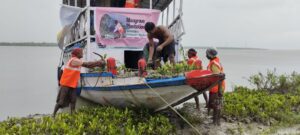
Mangrove forests are highly productive ecosystems, providing critical services that benefit all of us. Go Dharmic is working towards planting 2 million mangrove trees in the delicate ecosystem of Sundarbans. We plan to achieve this target in the next 3 years in phases.
An essential part of our ongoing efforts to restore natural habitat under our Go Green campaign is restoring mangroves to the shoreline. West Bengal, the South 24 Parganas, which faced the maximum brunt of Cyclone Amphan, was a reminder that the Sundarbans is at significant risk and needs conservation efforts immediately. The importance of mangrove planting cannot be understated to help protect and restore the vital Sundarban treasure. Go Dharmic has been relentlessly working in the region, providing all necessary aid to the communities living there.
Each mangrove plant costs us Rs10. We aim to plant 2 million trees in the next 3 years under the #Giveitagrow campaign. We realise that it’s a big feat and we also know that with your help we can do it!
Here are just a few reasons we should care about mangroves and start protecting them:
1. They are a natural coastal defence
If there are no mangrove forests, then the sea will have no meaning. It is like having a tree with no roots, for the mangroves are the roots of the sea.
The sturdy root systems of mangrove trees help form a natural barrier against violent storm surges and floods. Mangroves provide valuable protection for communities at risk from sea-level rises and severe weather events like storms and tsunamis caused by climate change, as seen in the recent Bengal cyclones, Amphan and Yaas.
2. They are carbon sinks
Mangrove forests sequester carbon at a rate two to four times greater than mature tropical forests and store three to five times more carbon per equivalent area in their carbon-rich flooded soils for millennia. When mangrove forests are cleared and destroyed, they release massive amounts of carbon dioxide into the atmosphere, contributing to climate change.
According to a recent study, A new study finds mangrove soil held around 6.4 billion metric tons of carbon in 2000. Between 2000 and 2015, up to 122 million tons of this carbon was released due to mangrove forest loss – roughly equivalent to the annual emissions of Brazil. More than 75% of these soil carbon emissions came from mangrove deforestation in just three countries: Indonesia, Malaysia and Myanmar.
3. They encourage ecotourism
Sustainable tourism offers a stimulus to preserve existing mangrove areas, potentially generating income for local inhabitants. Often located near coral reefs and sandy beaches, the forests provide a rich environment for sports fishing, kayaking and birdwatching tours.