

Dear Beloved Community,
In the glow of Diwali, I am filled with gratitude to each of you for being on this journey of dharma. As we celebrate the triumph of light over darkness, I feel a deep responsibility to honour that light, not only within ourselves but in all beings. Today, I write to you with a heartfelt invitation to consider a path that brings our actions into harmony with ahimsa—the principle of non-violence that lies at the very heart of dharma. This means us lightening the violence we are causing to the animal kingdom and to nature. Go Dharmic distributes food and aid to people in need all over the world, and it is important that we extend the love we feel for other people to include animals and nature too.
Go Dharmic is not just a humanitarian charity. We are a movement and platform for compassion in action. As many esteemed global charitable organisations focus on treating the symptoms, we apply efforts to advocate for peace and address the systemic disease that causes them in the first place: violence. I was personally shocked and upset to see beef being served at important events like COP or even at some major humanitarian charity events. These are supposed to be the leaders of peace and compassion in the world and yet choose to ignore the harm of violence to animals.
Sanatana Dharma calls us to revere every form of life, to ease suffering, and to live in harmony with all beings. The Mahabharata reminds us,
“Ahimsa is the highest dharma. Ahimsa is the best of all teachings(Mahabharata 13.117.37)”
We should live gently upon this Earth, to see ourselves in all creatures, and to recognise the interconnected web that binds us all. It is in this spirit that Go Dharmic is a vegan organisation—not just as a dietary choice, but as a profound expression of our values of compassion, non-harming, and respect for the Earth and all her beings. When we serve and receive meals through our distributions or during disasters, when guests visit one of our retreats or join us at one of our centres, it is important that we serve food that does not include animal products.
Krishna says, “Dharma is love for all beings”. And these words are always in my mind and are central for our work and remind me that each being holds within it the same divine spark and the same essence. By choosing veganism as individuals and as a community, we choose to extend our compassion to animals, respecting their inherent right to live free from harm. Our relationship with animals should be one of guardianship, not exploitation. The practice of ahimsa calls us to end the suffering we impose on sentient beings—beings who, like us, seek to live, love, and avoid suffering. By simply choosing to avoid animal products, we choose not to participate in a system that inflicts pain and fear, but to embody the principle of non-violence in a way that honours all life.
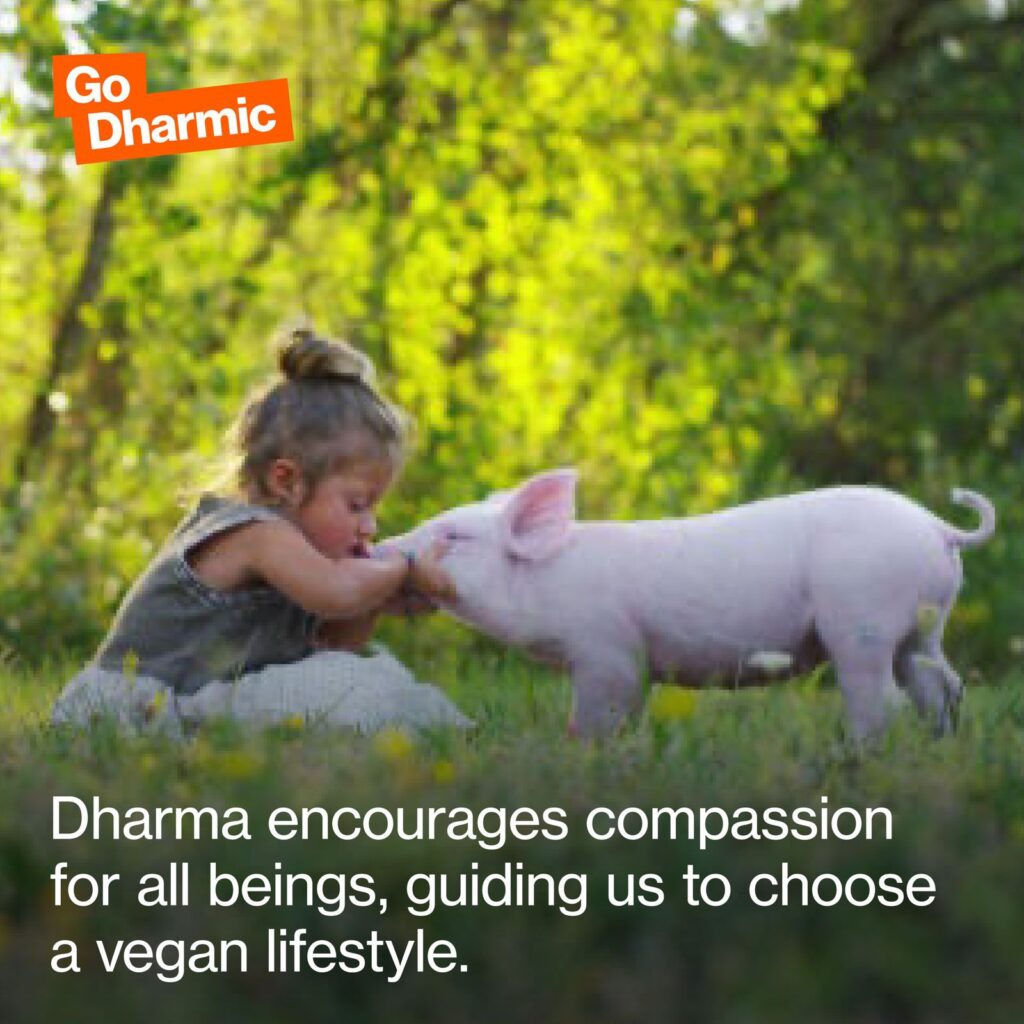
The Rigveda speaks to the sanctity of all life, declaring, “May all beings look at me with a friendly eye, and may I do likewise; may all beings look at each other with a friendly eye” (Rigveda 10.191.4). Justice is not limited to human society alone but extends to all beings who share this Earth. When we choose compassion over consumption, we are not only upholding the rights of animals but affirming the justice that should guide all our relationships. Our ethical responsibility includes treating animals with dignity, acknowledging their suffering, and striving for a more just and kind world. Let us not argue about what people did in the past, whether they consumed meat, or dairy or any specific circumstances as examples but let us look at the tremendous evidence of the suffering of animals, violence to our planet and ourselves. If we apply and engage our ethical or dharmic compass with intelligence we will find that veganism is a very practical and simple solution to heal nature and reduce harm to nature whilst still living well.
Modern science has underscored the urgency of these choices. Research on planetary boundaries, particularly by the Stockholm Resilience Centre, has identified critical thresholds in areas like climate change, deforestation, and biodiversity loss. Animal agriculture, including the dairy industry, is one of the primary drivers pushing us beyond safe boundaries, fuelling deforestation, greenhouse gas emissions, and the depletion of our planet’s natural resources. Many will choose to do nothing about it, but the call to ‘Go Dharmic’, is one for us to take responsibility.
In the Mahabharata, there was a wise merchant Tuladhara who encountered the sage Jajali, who had spent years practising severe austerities, renouncing worldly attachments, and engaging in rigorous sacrifices. Jajali, proud of his accomplishments, believed he had attained the highest form of dharma and purity. Seeking validation, he asked Tuladhara about the merit of his practices. In response, Tuladhara shared a profound lesson on ahimsa and the path of least harm.
Tuladhara says:
“Ahimsa paramo dharmah”
“Non-violence is the highest dharma.”
Tuladhara adds that compassion and empathy are the roots of true spirituality, saying:
“One who truly understands dharma acts with kindness, not out of adherence to rules, but from a heartfelt desire to see all beings at peace. For such a person, all beings are part of their own family.”
He underscores that merely following strict austerities, as Jajali had done, does not embody true dharma. Instead, the essence of dharma lies in recognising the interconnectedness of all life and embodying ahimsa in every thought, word, and action.
This dialogue serves as a powerful reminder to us that the essence of dharma is compassion and non-harm, a teaching that has echoed through the centuries and I believe is one of the core teachings of Hinduism, Buddhism, Sikhism and Jainism.
Tuladhara taught Jajali that living in harmony with others, showing compassion to all beings—whether human, animal, or nature—is a truer and higher form of dharma than any sacrifice.
Jajali, who was humbled realised that while he had lived with great austerity, he had missed the essence of dharma: living with compassion and walking a path of gentleness, choosing actions that brought peace rather than harm. Through his story, Tuladhara shows us that the greatest spiritual strength lies not in conquering oneself through rigid discipline or rituals, but in nurturing a heart that is gentle, kind, and mindful of the well-being of all creation.He says:
“One should walk the path that causes the least harm to all beings, for in sparing others, one preserves their own purity and the world’s balance.”
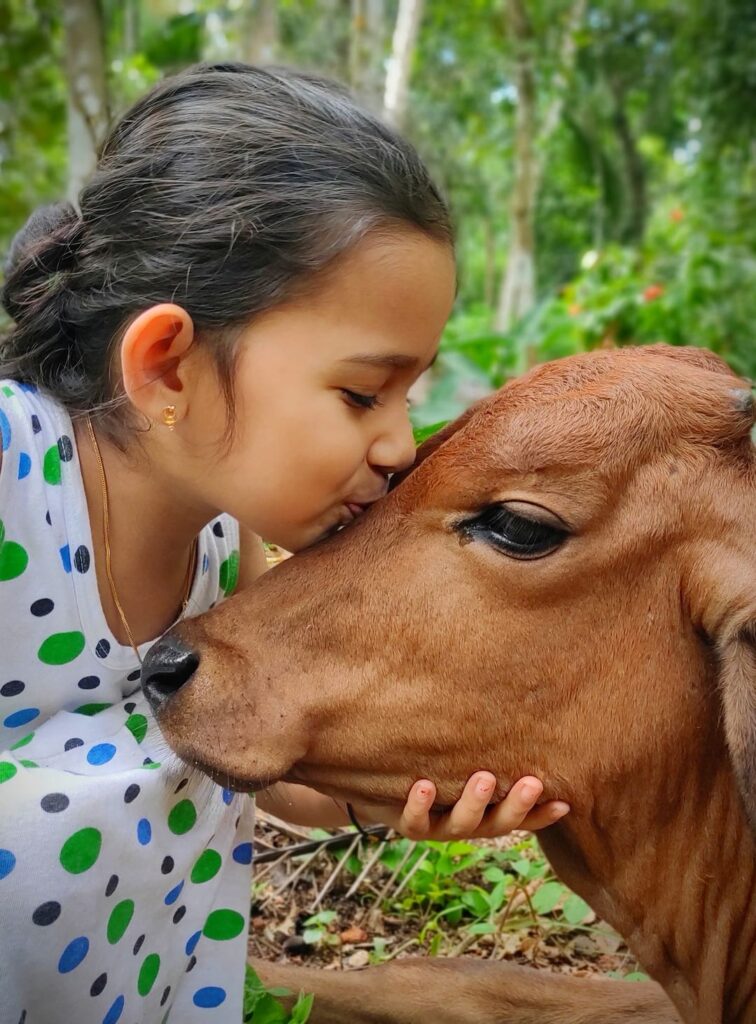
From an individual health perspective, a plant-based diet offers numerous benefits. Studies from institutions like Harvard and the World Health Organization show that whole-food plant based diets rich in fruits, vegetables, and whole grains can reduce the risk of heart disease, diabetes, and certain cancers. By choosing a diet that is lighter on the body and the Earth, we honour this vessel, nourishing our health in a way that aligns with our dharmic values.
As we navigate the ecological crises of our time, adopting a vegan lifestyle is one of the most direct and powerful ways to make peace with nature. The Atharva Veda invokes, “May peace radiate in the whole sky, and in the vast ethereal space; may peace reign all over this Earth, in water and in all herbs, trees and creepers” (Atharva Veda 19.9.14). When we change our lifestyle to be one without violence, we contribute to peace, reducing deforestation, conserving water, and protecting nature’s ecosystems that are essential for life.
For many, this choice may not be easy, and there may be questions and challenges along the way. Let us support each other as a family, offering compassion to each other as we walk this path. By cultivating ahimsa in our lives, we deepen our practice, aligning our daily choices with the love we hold in our hearts. Each vegan meal served becomes an opportunity to honour the Earth, protect animals, and embody justice.
This letter is an invitation—a call to apply dharma personally and as a community by embracing a way of life that is rooted in compassion, justice, and ecological harmony. Veganism, when practised with love can ease suffering but embody the spirit of ahimsa, creating a world where all beings can thrive. May we walk this path with courage and wisdom, knowing that our choices have the power to shape a more loving and just world.
With deep love and gratitude.
Hanuman Dass