CONQUERING MOUNT SNOWDON!

Mount Snowdon Banner

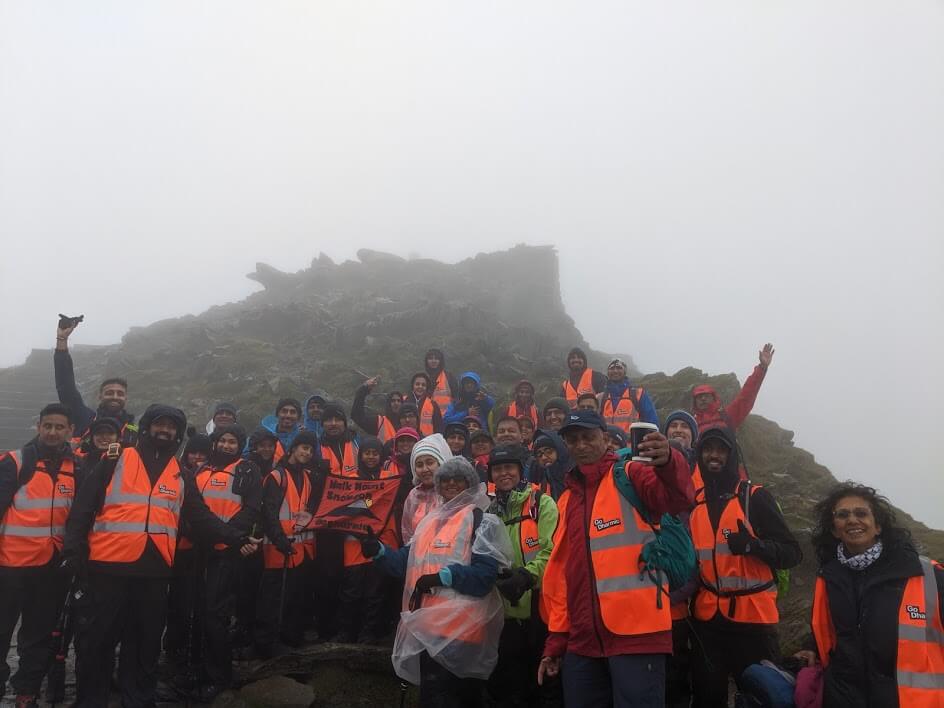
Last weekend, a group of 45 brave Go Dharmic volunteers climbed Mount Snowdon, the highest mountain in Wales! It’s 1,085 meters above sea level and is located in the Snowdonia National Park, Gwynedd. The mountain is famous for its stunning views and picturesque scattered villages in the region, however, it’s also known for its lack of shelter from the elements and sharp peaks. Unfortunately, the weekend was forecast for rainy and windy weather, making the walk a little harder than usual. Despite all of this, our volunteers all persevered, and conquered Mount Snowdon!  ‘The Snowdon challenge for me was one of the most amazing things I’ve ever done. The team with our guides who are now great friends, Kaushik Uncle, and Rahul Uncle gave 100% throughout from training to the actual day, the energy and love between the group were uplifting. The experienced members helped those who needed and made sure everyone was safe and motivated. We reached over and beyond our fundraising target to over £10k for Go Dharmic campaigns. I am truly proud of everyone who took part and accomplished this, especially the younger ones Krish and Daven. I look forward to future events with Go Dharmic. The best thing out of this for me is the friendships and bonds which have been made will stay with me for a lifetime.’ Urshna Aiyer

The group of volunteers was a mix of individuals from different areas in the UK and different ages. The youngest walkers, Krish Tailor and Dhaven Tailor were just 10 years old. The diversity of the group only aided them more, the younger participants helped to motivate those who were finding it a little more difficult, the team spirit was truly amazing. ‘It was uplifting to see all the “younger ones” with full of energy and determination to complete their goal. Well done. Congratulations once again for giving me an opportunity and an experience of meeting you. ALL THE BEST TO GO DHARMIC AND CONTINUE YOUR GOOD WORK.’ Falguni Patel  We would like to say a huge thank you to the guides, Kaushik Shah and Rahul Haria, who led the team through the rocky terrain and kept them safe at all times. They also provided a fantastic training program, ensuring that everyone was fit and ready for the climb. 

Kaushik Shah shared this lovely quote with us:  ‘You cannot stay on the summit forever; you have to come down again. So why bother in the first place? Just this: What is above knows what is below, but what is below does not know what is above. One climbs, one sees. One descends, one sees no longer, but one has seen.’

Rahul Haria said: ‘If you got the trekking bug it will never be over! And memories of Go Dharmic will always be alive as every future Go Dharmic trek you will talk about the 1st one at Snowdon – especially walking in the dark!’ Our volunteers were given a fundraising target of £5,000 between the group. Their amazing fundraising efforts have raised just under £10,000 for Go Dharmic! There is still time to donate, and help them to fundraise double their target, follow the link below to donate.  https://www.justgiving.com/campaign/Snowdonchallenge ‘Six months ago the challenge was set to for a group of novice walkers to reach the summit of Snowdon in Wales at 1085 meters this was no small task. Through months of training and preparation of 45 people, the team showed great courage and determination to make it to the top by helping each other to get over their own personal challenges as well as the constant changes in conditions of high winds, heavy rain, and cold mist. I am really proud of everyone who made this a success and in the process, we have raised nearly £10,000 towards Go Dharmic Campaigns.’ Ajay Randerwala

A huge well done to all of the volunteers, for their hard work training over the past 3 months, and for completing the climb on the 28th of September 2019. We hope to see you all again next year for a new challenge! If you’d like to get involved next year or have an idea of what our next challenge could be, please email info@godharmicstag.wpenginepowered.com

‘Thank you, everyone, for this fantastic opportunity to walk this great mountain. Great support from everyone, I will be hoping we can all do another one next year. Maybe 3 peaks in 24hrs!’ Nimesh Gokal

‘A massive thank you to Kaushik uncle, Rashmita auntie, Rahul uncle Meena aunty for all the training and support. Additionally a very big thank you to the uncle and aunty that made all the food. A big thank you to the whole GD team for the organization and help throughout. A special mention to everyone that helped me and Vishal get up and down, Ajay, Barry, Chatan, Rahul uncle, Arti, Kaushik uncle, Rashmita aunty and anyone else I’ve missed! Without you guys, we would still be at the peak! Lastly a massive thank you to the whole group, family and friends for making the experience an unforgettable one and for the support all throughout!!’ Deepali Songara

To see the amazing photos from the climb: https://photos.app.goo.gl/Ltx7HBBmYQqQH4Vv9

Support Go Dharmic

MOVED BY THIS STORY?

[gd_subscription_monthly]

ACT NOW

Our campaign ‘Go Plant-Based’ focuses on using plant-based products in our daily lives. It reduces the load on natural resources like air, water, and land.

Select one of the following options to our Go Plant-Based Campaign

1. Vegetarian

2. Vegan

#VeganByChoice

Some facts and figures :

  • Researchers at the University of Oxford found that cutting meat and dairy products from your diet could reduce an individual’s carbon footprint from food by up to 73 percent.

  • The global contribution of animal farming to GHG emissions is agreed to be 14.5% more than the direct emissions from all transport combined. – The Vegan Society

  • Rearing livestock doesn’t just produce a lot of greenhouse gases – it has other impacts on the environment too. Every kilogram of beef produced requires around 15,400 liters of water, according to a report from UNESCO’s Institute for Water Education.

PROBLEM

The animal agriculture industry plays a major role in dietary greenhouse gas emissions across the world. Overwhelming evidence from studies across the world regarding climate change suggests that from production to consumption the impact is great.

There are so many causes. From the land to foster animals, land to grow vegetation exclusively for livestock consumption, air pollution because of methane gas released by animals, and water pollution due to the excretion and improper discard of animal waste.

Apart from fostering, the meat food waste emits more CO2 in the atmosphere when left untreated. Experts believe that animal agriculture is the biggest source of greenhouse gas emissions, greater than all the transportation systems of the world combined.

Some facts and figures:

-The Environmental Protection Agency states that raising animals for food is the number-one source of water pollution.
-United Nations states that the meat, egg, and dairy industries account for about 65 per cent of worldwide nitrous oxide emissions.

-An Oxford University study, published in the journal Climatic Change, shows that meat-eaters are responsible for almost twice as many dietary greenhouse-gas emissions per day as vegetarians and about two and a half times as many as vegans.

-According to studies, animal agriculture globally, is the single largest component responsible for maximum methane gas release in the atmosphere.
-The meat industry is directly responsible for 85 per cent of all soil erosion in the U.S, states PETA.

Choosing an animal-based diet is often the elephant in the room. It is often overlooked as we as a global community are working to curb climate change

Turning to a plant-based diet is an easy fix.

Solution

With evolving technology, we surely have got many options to choose from on how we wish to travel for work or to the nearest stores for respective reasons.
The small decisions that we make on a day-to-day basis, actually determines the kind of climate we experience over a period of time.
Hence here are some options which can have a big impact if all of us do our bit towards it.

-Shift to fuel-less travel options like cycling or walking to your workplace or nearest grocery store whenever possible.
-Increase the use of public transport.
-Opting for sharing/pooling options while travelling with friends or family.

PROBLEM

The air pollution caused by the transport industry is an alarming situation globally.
Amongst all kinds of transport means, road transport is the largest contributor to global warming. Usage of petroleum, oil and fossil fuels for transportation emits various gases that concerns our environment.
Out of the six gases which are formally identified by the United Nations Framework Convention for Climate Change (UNFCCC) , three of them are related to the transport sector. They are – carbon dioxide, methane, and nitrous oxides. Emission of all three gases acts as a significant contributor to global warming.

There are various factors under transportation that determine the air pollution caused by it. Here are a few of them :
1. Excessive use of vehicle
2. Evolving technology
3. Poor maintenance of vehicles
4. Usage of substitute fuels instead of the ones set out by the Environment Board of a particular city/state.

Transport industry is one of the major contributors of producing greenhouse gases, especially in countries like the UK and the US.

Facts and Figures:

One of the reports from BBC states that –

The average petrol car on the road in the UK produces the equivalent of 180g of CO2 every kilometre, while a diesel car produces 173g of CO2/km.

In the US the average passenger vehicle on the road releases 650g of CO2/km. Generally, the larger the car, the higher the emissions.

CO2 emissions from passenger transport vary significantly depending on the transport mode. Passenger cars are a major polluter, accounting for 60.7% of total CO2 emissions from road transport.

SOLUTION

We can opt for options which are environment friendly. When we consume less electricity, we reduce polluting carbon emissions that is caused because of the release of toxic fuels burnt due to electricity generation.

A simple change in our behaviour can help us save the environment. These changes are simple as:

  1. Switching off the lights, fans and other electric and electronic devices when not in use.
  2. Using LED lights and bulbs, as they consume very little electricity and don’t produce much heat
  3. Switch to renewable sources of energy.
  4. Using solar energy and wind energy wherever possible.

FACTS
Reducing your PC monitor brightness from 100% to 70% can save up to 20% of the energy the monitor uses. (Harvard)

-Mobile phone chargers, laptop docking stations and some desktop printers use energy regardless of whether they are charging or not because the voltage transformers on the plug consume energy. This is known as electrical leakage.

-A 15-second lift journey consumes as much energy as a 60W light bulb does in an hour states Cambridge University.
-If you ensure that just 4 lights around your workspace are switched off every night, each year you could:

  1. Save as much CO2 is produced by 20 car trips from London to Paris.
  2. Reduce your carbon footprint by the same amount as cutting out 10 flights from London to Paris.

-According to Energy Saving Trust, turning off unneeded lights could remove 171 kg (376 lb) of CO2 emissions per year.

-A single light left on overnight over a year accounts for as much greenhouse gas as a car drive from Cambridge to Paris. – University of Cambridge

-Nearly 50% of the CO2 emissions produced by the UK come from heating and cooling in buildings. – States Carbon Trust

PROBLEM

The cost of generating electricity is the largest component of the price of electricity. – U.S Energy Information Administration

!! The UK wastes £170 million a year by leaving lights on unnecessarily states Energy Saving Trust, UK !!

Roughly 50 devices and appliances in the typical American household are always drawing power, even when they appear to be off, estimates Alan Meier, a senior scientist at the Department of Energy’s Berkeley Lab.

More than often, we tend to neglect and leave lights and switches on when not in use. This negligence results in the over-consumption of electricity which contributes significantly to carbon emissions that harm the environment.

About a quarter of all residential energy consumption is used on devices in idle power mode, according to a study of Northern California by the Natural Resources Defense Council. This means that devices that are “off” or in standby or sleep mode can use up to the equivalent of 50 large power plants’ worth of electricity and cost more than $19 billion in electricity bills every year.

The environmental cost this takes is – overall electricity production represents about 37 percent of all carbon dioxide emissions in the United States, one of the main contributors to climate change.
There are various factors that affect energy consumption. Some of these are:

  1. Lights, Fans/Heaters turned on when not in use.
  2. Switches of various electronic items such as blenders, washing machines, televisions, and mobile charging plugs that are left on when not in use.
  3. Usage of high watt lights and bulbs.
  4. Excess usage of air conditioners. Even at a very low temperature, AC units consume high amounts of electricity.

DID YOU KNOW?

Electric power lines and other distribution infrastructure also have a footprint!
Electricity transmission lines and the distribution infrastructure that carries electricity from power plants to customers also have environmental effects. Most transmission lines are above ground on large towers. The towers and power lines alter the visual landscape, especially when they pass through undeveloped areas. Vegetation near power lines may be disturbed and may have to be continually managed to keep it away from the power lines. These activities can affect native plant populations and wildlife. Power lines can be placed underground, but it is a more expensive option and usually not done outside of urban areas.

Source – U.S Energy Information Administration

Thank you for choosing to Switch And Save

Thank you for choosing to Go Fuel Free

Thank you for choosing to Go Plant Based

Error: Contact form not found.

Error: Contact form not found.