
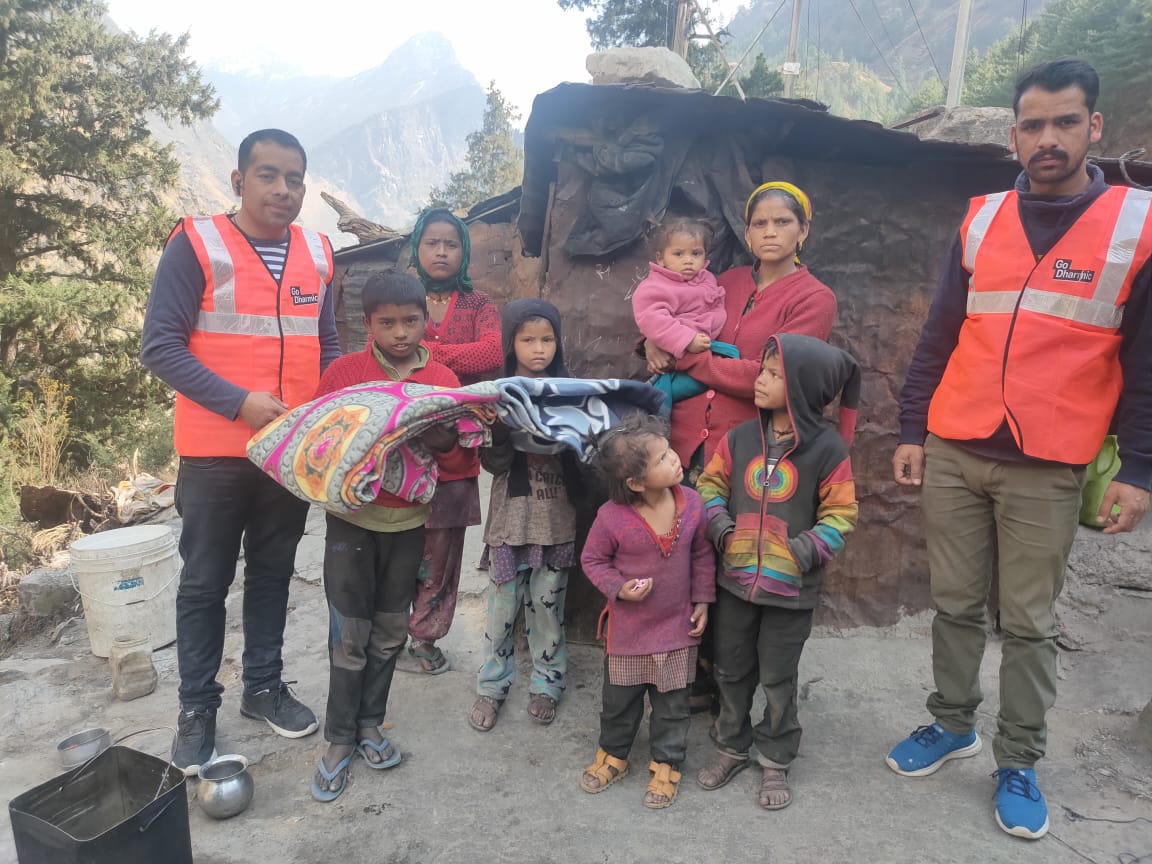
Go Dharmic volunteers reach the worst affected by the Glacier Burst in Uttarakhand

Go Dharmic volunteer teams make it to the worst effected by the Glacier burst in Uttarakhand, India Banner

Go Dharmic announced on Feb 13th a goal to help feed the vulnerable across the affected areas of Chamoli in Uttarakhand in light of the recent glacier burst caused when a portion of the Nanda Devi glacier snapped off 7th morning, sending a devastating avalanche of water and debris down a mountain, sweeping away everything in its path. Many families lost their homes, the impact of the burst was felt all over the city, buildings collapsed, windows were blown in, and hundreds of people lost their loved ones. At least 54 people are dead and 150 are missing so far.

Go Dharmic volunteers who live in the neighbouring areas, started relief work straight away by providing ration kits of daily food staples such as wheat flour, lentils, rice, salt, spices and vegetables. In the short time since the team of volunteers has delivered over a thousand meals and is planning to deliver more by the end of the month. We hope to increase the frequency and to be able to reach more people!

Our superhero, Sagar Pandey from Nainital remarked,

“The area where the avalanche and flooding occurred is extremely remote and mountainous and it can take days to reach some of the villages dotted throughout the valleys. We are at ground zero where people are stranded and stuck due to glacier disaster and are constantly assessing the situation and trying to fulfil need-based requirements in coordination with state disaster authority.”

https://www.youtube.com/embed/b3wHFy2V4u0

Santosh Kunwar from Auli village, Chamoli, added “The outburst of the glacier shot up the water levels of Alaknanda which in turn washed away 2 major hydroelectric stations, broke through dams and swept several small bridges connecting the villages. Joshimath-Malari bridge which was extensively used by Indian Army to go to the border areas has also been washed away because of heavy flooding in Dhauli Ganga river. Homes along the way were swept away as the waters rushed down the mountainsides in a raging torrent. Many villages were evacuated and people took to safer areas last week. The destruction of several motorable and smaller pools led to the cutting off of contact through the road, so families are running low on food supplies, and many people are experiencing hunger. Our team is helping rescue operations in airdropping and providing Ration to villages beyond the Raini bridge that was swept away in floods. The packs include enough food to last a family for at least a month, the contents comprise highly nutritious ingredients which will provide substantial meals to vulnerable families, and will keep them full for long periods of time.”

Go Dharmic has come out in the support of the families who have been badly affected in the wake of the avalanche. Our primary focus will be on the bereaved families who have lost their sole bread earners to bear this sorrow and to provide immediate food supplies, clothes and other essentials to them for the next few months till things return to normal.

Kindness comes easy to some, and our volunteers including Jinu, Major and Neeraj from Gunialekh village, Nainital are being lauded for their humanitarian work despite the harsh conditions prevalent there. These good Samaritans have been working tirelessly day and night along with Rescue teams to find survivors trapped under the debris. Most of those missing are workers from two hydroelectric projects at Reni village in Uttarakhand’s Chamoli district, which were hit by the avalanche.

https://www.youtube.com/embed/b3wHFy2V4u0

Hemal Randerwala, Founder & Chairman, Go Dharmic, said

“These are unprecedented times for the people of Uttarakhand and we have a larger humanitarian responsibility to address the needs of those most affected by the disaster. The impact Go Dharmic is having on the lives of the most vulnerable in Chamoli and affected areas are immense. We are constantly monitoring the unfortunate situation in Uttarakhand. Our team is working with local shops, businesses and organisations to procure all of the items for the ration kits, and shortlisting the most vulnerable and devastated areas in Chamoli. We realize that our work is more than just giving out food relief but building a sense of solidarity and community in the time where it matters the most. Dharma is love for all beings and it is our duty to the people of Chamoli right now. Much more can still be done. If you have time, resources or the will to help others in our community, get involved to help people in Uttarakhand.”

At Go Dharmic, it’s About Loving All, Feeding All, and Serving All. Our contribution is to spread the essence of Dharma throughout the world and to change the world into something we are proud of. Being a Dharma Patron isn’t just about making a monthly donation, it’s about being part of a community of like-minded individuals who all want to make changes to their lifestyle and the world to make it a better place.  The Dharma Patrons have funded the development of over 74 libraries, 3.2 million meals, and many cataract eye operations. You can make a difference and become the newest member of the family of Dharma Patrons by donating any amount.

Help us provide relief to Uttarakhand flood victims, by signing up here:

Sign Up Here

To help GD feed even more people in need during this difficult time, please donate and help us fund more meals and essentials.

https://www.youtube.com/embed/b3wHFy2V4u0
Support Go Dharmic

MOVED BY THIS STORY?

[gd_subscription_monthly]

ACT NOW

Our campaign ‘Go Plant-Based’ focuses on using plant-based products in our daily lives. It reduces the load on natural resources like air, water, and land.

Select one of the following options to our Go Plant-Based Campaign

1. Vegetarian

2. Vegan

#VeganByChoice

Some facts and figures :

  • Researchers at the University of Oxford found that cutting meat and dairy products from your diet could reduce an individual’s carbon footprint from food by up to 73 percent.

  • The global contribution of animal farming to GHG emissions is agreed to be 14.5% more than the direct emissions from all transport combined. – The Vegan Society

  • Rearing livestock doesn’t just produce a lot of greenhouse gases – it has other impacts on the environment too. Every kilogram of beef produced requires around 15,400 liters of water, according to a report from UNESCO’s Institute for Water Education.

PROBLEM

The animal agriculture industry plays a major role in dietary greenhouse gas emissions across the world. Overwhelming evidence from studies across the world regarding climate change suggests that from production to consumption the impact is great.

There are so many causes. From the land to foster animals, land to grow vegetation exclusively for livestock consumption, air pollution because of methane gas released by animals, and water pollution due to the excretion and improper discard of animal waste.

Apart from fostering, the meat food waste emits more CO2 in the atmosphere when left untreated. Experts believe that animal agriculture is the biggest source of greenhouse gas emissions, greater than all the transportation systems of the world combined.

Some facts and figures:

-The Environmental Protection Agency states that raising animals for food is the number-one source of water pollution.
-United Nations states that the meat, egg, and dairy industries account for about 65 per cent of worldwide nitrous oxide emissions.

-An Oxford University study, published in the journal Climatic Change, shows that meat-eaters are responsible for almost twice as many dietary greenhouse-gas emissions per day as vegetarians and about two and a half times as many as vegans.

-According to studies, animal agriculture globally, is the single largest component responsible for maximum methane gas release in the atmosphere.
-The meat industry is directly responsible for 85 per cent of all soil erosion in the U.S, states PETA.

Choosing an animal-based diet is often the elephant in the room. It is often overlooked as we as a global community are working to curb climate change

Turning to a plant-based diet is an easy fix.

Solution

With evolving technology, we surely have got many options to choose from on how we wish to travel for work or to the nearest stores for respective reasons.
The small decisions that we make on a day-to-day basis, actually determines the kind of climate we experience over a period of time.
Hence here are some options which can have a big impact if all of us do our bit towards it.

-Shift to fuel-less travel options like cycling or walking to your workplace or nearest grocery store whenever possible.
-Increase the use of public transport.
-Opting for sharing/pooling options while travelling with friends or family.

PROBLEM

The air pollution caused by the transport industry is an alarming situation globally.
Amongst all kinds of transport means, road transport is the largest contributor to global warming. Usage of petroleum, oil and fossil fuels for transportation emits various gases that concerns our environment.
Out of the six gases which are formally identified by the United Nations Framework Convention for Climate Change (UNFCCC) , three of them are related to the transport sector. They are – carbon dioxide, methane, and nitrous oxides. Emission of all three gases acts as a significant contributor to global warming.

There are various factors under transportation that determine the air pollution caused by it. Here are a few of them :
1. Excessive use of vehicle
2. Evolving technology
3. Poor maintenance of vehicles
4. Usage of substitute fuels instead of the ones set out by the Environment Board of a particular city/state.

Transport industry is one of the major contributors of producing greenhouse gases, especially in countries like the UK and the US.

Facts and Figures:

One of the reports from BBC states that –

The average petrol car on the road in the UK produces the equivalent of 180g of CO2 every kilometre, while a diesel car produces 173g of CO2/km.

In the US the average passenger vehicle on the road releases 650g of CO2/km. Generally, the larger the car, the higher the emissions.

CO2 emissions from passenger transport vary significantly depending on the transport mode. Passenger cars are a major polluter, accounting for 60.7% of total CO2 emissions from road transport.

SOLUTION

We can opt for options which are environment friendly. When we consume less electricity, we reduce polluting carbon emissions that is caused because of the release of toxic fuels burnt due to electricity generation.

A simple change in our behaviour can help us save the environment. These changes are simple as:

  1. Switching off the lights, fans and other electric and electronic devices when not in use.
  2. Using LED lights and bulbs, as they consume very little electricity and don’t produce much heat
  3. Switch to renewable sources of energy.
  4. Using solar energy and wind energy wherever possible.

FACTS
Reducing your PC monitor brightness from 100% to 70% can save up to 20% of the energy the monitor uses. (Harvard)

-Mobile phone chargers, laptop docking stations and some desktop printers use energy regardless of whether they are charging or not because the voltage transformers on the plug consume energy. This is known as electrical leakage.

-A 15-second lift journey consumes as much energy as a 60W light bulb does in an hour states Cambridge University.
-If you ensure that just 4 lights around your workspace are switched off every night, each year you could:

  1. Save as much CO2 is produced by 20 car trips from London to Paris.
  2. Reduce your carbon footprint by the same amount as cutting out 10 flights from London to Paris.

-According to Energy Saving Trust, turning off unneeded lights could remove 171 kg (376 lb) of CO2 emissions per year.

-A single light left on overnight over a year accounts for as much greenhouse gas as a car drive from Cambridge to Paris. – University of Cambridge

-Nearly 50% of the CO2 emissions produced by the UK come from heating and cooling in buildings. – States Carbon Trust

PROBLEM

The cost of generating electricity is the largest component of the price of electricity. – U.S Energy Information Administration

!! The UK wastes £170 million a year by leaving lights on unnecessarily states Energy Saving Trust, UK !!

Roughly 50 devices and appliances in the typical American household are always drawing power, even when they appear to be off, estimates Alan Meier, a senior scientist at the Department of Energy’s Berkeley Lab.

More than often, we tend to neglect and leave lights and switches on when not in use. This negligence results in the over-consumption of electricity which contributes significantly to carbon emissions that harm the environment.

About a quarter of all residential energy consumption is used on devices in idle power mode, according to a study of Northern California by the Natural Resources Defense Council. This means that devices that are “off” or in standby or sleep mode can use up to the equivalent of 50 large power plants’ worth of electricity and cost more than $19 billion in electricity bills every year.

The environmental cost this takes is – overall electricity production represents about 37 percent of all carbon dioxide emissions in the United States, one of the main contributors to climate change.
There are various factors that affect energy consumption. Some of these are:

  1. Lights, Fans/Heaters turned on when not in use.
  2. Switches of various electronic items such as blenders, washing machines, televisions, and mobile charging plugs that are left on when not in use.
  3. Usage of high watt lights and bulbs.
  4. Excess usage of air conditioners. Even at a very low temperature, AC units consume high amounts of electricity.

DID YOU KNOW?

Electric power lines and other distribution infrastructure also have a footprint!
Electricity transmission lines and the distribution infrastructure that carries electricity from power plants to customers also have environmental effects. Most transmission lines are above ground on large towers. The towers and power lines alter the visual landscape, especially when they pass through undeveloped areas. Vegetation near power lines may be disturbed and may have to be continually managed to keep it away from the power lines. These activities can affect native plant populations and wildlife. Power lines can be placed underground, but it is a more expensive option and usually not done outside of urban areas.

Source – U.S Energy Information Administration

Thank you for choosing to Switch And Save

Thank you for choosing to Go Fuel Free

Thank you for choosing to Go Plant Based

Error: Contact form not found.

Error: Contact form not found.