Campaigning Climate Justice: InterFaith Loss and Damage Day

civil rights movement

It is as clear as day that Loss and Damage is a social justice issue as important as the civil rights movement. Loss and Damage is marching alongside all who suffer in silence. It is my faith in Vasudhaiva Kutumbakam (the idea that we are all one human family) that wholly influences my work” — Hanuman Dass, Go Dharmic’s Founder

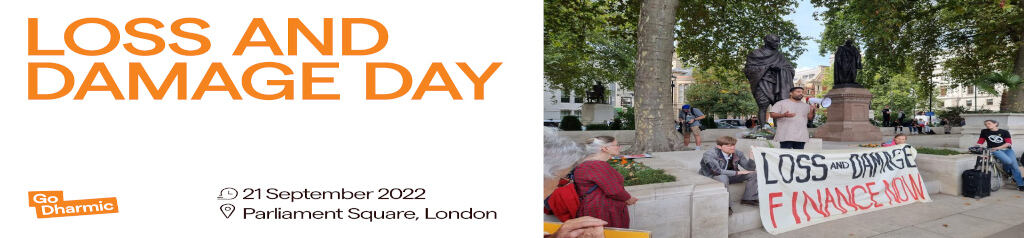
Loss And Damage Day was a tremendous success! We marched for peace, held a Silent Vigil outside Fossil Fuel Corp. Shell, and Fasted in front of the Gandhi Statue in Parliament Square. 

It was a truly momentous occasion where so many faith and secular groups were brought together in pure compassionate devotion to our planet and the protection of all living beings. We were united in a loving spirit for the protection and prosperity of our planet and all persons. 

The key phrase, “Loss and Damage”, is about campaigning for those responsible for the climate chaos – negligent big businesses and short-sighted governments – to pay reparations to those countries most affected. Hence, the hashtags #PayUpForLossAndDamage, and #FastForClimateJustice

The list of groups who joined us at the event included: 

  • Global Justice Now
  • Quakers for Climate Justice
  • Catholic Agency for Overseas Development,
  • Christian Climate Action Extinction Rebellion, •EcoDharma
  • Christian aid
  • Faith for the climate
  • Plus many others.

We were even joined by UK MP, Caroline Lucas, who offered the profound: “What we are seeing right now is, nothing less than, a crisis of epic proportion… It is time for the rich countries to pay up for loss and damage — to step up, and pay up. We know that the World is not short of money, so don’t ever let them pretend that we cannot afford to do this. Look no further than those huge fossil fuel companies, pocketing obscene profits.

Canon Giles Goddard, the Chair of faith for the climate, who helped arrange and manage the event said that his Christian belief was at the core of his devotion to Loss and Damage: “Justice is right at the heart of Christian faith. We always say justice is love enacted. If we’re called to love the world, then we have to love everybody in it. If we’re called to love everybody in it, then we are called to make sure the world is fair for them. Loss and Damage is right at the heart, because we’ve disproportionately contributed to it in the West, and we must address our part in it.

In Parliament square, Rabbi Johnathan Wittenberg, the Senior Rabbi of Masorti Judaism UK, gave a speech motivated by his Jewish faith that, “there is no such thing as confession without reparation, and that is where Loss and Damage comes in with a commitment to care, to work for environmental and social justice comes in, to work for the dignity of every human being.” a sentiment that we all championed.

Day Proceedings:

10:50 — We met at St. John’s and heard wonderful speeches and prayers from:

  • Canon Giles Goddard, Chair of faiths for the climate
  • Shanon Shah, Director of faith for the climate
  • Olivia Fuchs, Head of EcoDharma 

11:20 — We proceeded to walk down to Jubilee Gardens.

11:35 — We heard speech’s from:

  • Daniel Willis, Daniel Willis  Climate Justice campaigner for Global Justice Now
  • Paul Parker, Recording Clerk for Quakers in Britain

We then held a 10-minute silent vigil outside the Headquarters of Shell. 

12:00-12:40 — We walked down to Parliament Square and assembled in front of the Gandhi Statue. 

We then heard moving speeches from:

  • Our own Founder and Director, Hanuman Dass
  • Yusuf Baluch, Fridays for Future
  • Sadie DeCoste, Tipping Point
  • Caroline Lucas, MP
  • Rabbi Jonathan Wittenberg

Paul Parker, the Recording Clerk for Quakers in Britain, gave a powerful and haunting speech outside of Shell Headquarters, plaintively detailing the focus and importance of Loss and Damage : 

Today we are sending our message to those who will be gathering at Sharm-el-Sheikh for COP27 in November — it is time to make progress with loss and damage.”The climate crisis is here.  Events in Pakistan, Japan and even here in the UK in the last few weeks tell us that — again, and again — record extreme heat, melting ice, floods, cyclones are ravaging our world. This is not the world we seek for ourselves, or for those who will inhabit it after us. What do we bring to this, as people of faith? We bring our conviction that there is a fair, just world to be had, in which all can flourish. We bring our certainty that it is ours to create, and our commitment to doing so. We bring our faithfulness that we can be led to a place of justice. And, we bring our collective strength, solidarity and conviction. We speak with a loud and confident voice.

 Parker continued that “Climate justice is anti-racist work. The people most affected by the urgent and systemic crisis must be placed first in gaining this justice. If we have faith we will find many things to do but we cannot set the agenda without centering the experience and needs of people on the front line of climate change.

 That’s why today we are focusing on Loss and Damage. Loss and Damage caused by climate breakdown is a present reality for people around the world, and it is getting worse every year. For people in the global majority, extreme weather events (hurricanes, wildfires, flooding) and slow onset events (rising sea levels, desertification) are destroying lives, livelihoods and biodiversity.

 The millions of people worst affected are those who have done the least, and in many cases nothing, to cause the problem which is behind their suffering.  It is scandalous that the rich nations of the world, including the UK, have done so little to help the nations of the Global South to face up to, and to respond to the challenges we have caused.

 Our work on Loss and Damage is about placing justice and equality at the head of our climate action. Whether you consider it solidarity, compensation, or reparations, we know hundreds of billions a year are needed – and that money must come from those who caused the crisis.

 The building [Shell HQ] we have stopped outside stands here in Central London as a powerful symbol of what is wrong. As we pause here, let us take some time, in stillness and silence, to reflect.  Let us recognise, with discomfort, our own complicity in this challenge.

 Let us hold in the light the decision-makers, whose choices are not easy. Let us hold in the light those whose minds need to change, those who need to learn, to understand, to adapt, and to lead and drive change. But above all let us hold in the light those most affected by climate change. Those who have already lost, or will inevitably lose, their homes, their land, their loved ones, their livelihoods, their sense of security, their hope. Let us mourn their loss in silence together for a few minutes. And may that long silence stiffen our resolve to act.

Loss and Damage day was a startling and moving event. Given that still so few are aware of the meaning and purpose of the phrase “Loss and Damage” our work that day was a great step forward for getting the UK, Europe, and the World aware of it as a viable and important idea. Starting more locally, due to our efforts in preparation for the day, the subject of Loss and Damage was tabled for discussion in the UK’s House of Commons. 

Loss and Damage is not an action we can take alone as individuals. It requires governments and big business to take responsibility for their actions and come forward to protect the World. If we all continue to discuss Loss and Damage, we can help bring justice to those who are suffering.

The World Is Waking Up To Loss And Damage! 

#FastForClimateJustice

#PayUp4LossAndDamage

Support Go Dharmic

MOVED BY THIS STORY?

[gd_subscription_monthly]

ACT NOW

Our campaign ‘Go Plant-Based’ focuses on using plant-based products in our daily lives. It reduces the load on natural resources like air, water, and land.

Select one of the following options to our Go Plant-Based Campaign

1. Vegetarian

2. Vegan

#VeganByChoice

Some facts and figures :

  • Researchers at the University of Oxford found that cutting meat and dairy products from your diet could reduce an individual’s carbon footprint from food by up to 73 percent.

  • The global contribution of animal farming to GHG emissions is agreed to be 14.5% more than the direct emissions from all transport combined. – The Vegan Society

  • Rearing livestock doesn’t just produce a lot of greenhouse gases – it has other impacts on the environment too. Every kilogram of beef produced requires around 15,400 liters of water, according to a report from UNESCO’s Institute for Water Education.

PROBLEM

The animal agriculture industry plays a major role in dietary greenhouse gas emissions across the world. Overwhelming evidence from studies across the world regarding climate change suggests that from production to consumption the impact is great.

There are so many causes. From the land to foster animals, land to grow vegetation exclusively for livestock consumption, air pollution because of methane gas released by animals, and water pollution due to the excretion and improper discard of animal waste.

Apart from fostering, the meat food waste emits more CO2 in the atmosphere when left untreated. Experts believe that animal agriculture is the biggest source of greenhouse gas emissions, greater than all the transportation systems of the world combined.

Some facts and figures:

-The Environmental Protection Agency states that raising animals for food is the number-one source of water pollution.
-United Nations states that the meat, egg, and dairy industries account for about 65 per cent of worldwide nitrous oxide emissions.

-An Oxford University study, published in the journal Climatic Change, shows that meat-eaters are responsible for almost twice as many dietary greenhouse-gas emissions per day as vegetarians and about two and a half times as many as vegans.

-According to studies, animal agriculture globally, is the single largest component responsible for maximum methane gas release in the atmosphere.
-The meat industry is directly responsible for 85 per cent of all soil erosion in the U.S, states PETA.

Choosing an animal-based diet is often the elephant in the room. It is often overlooked as we as a global community are working to curb climate change

Turning to a plant-based diet is an easy fix.

Solution

With evolving technology, we surely have got many options to choose from on how we wish to travel for work or to the nearest stores for respective reasons.
The small decisions that we make on a day-to-day basis, actually determines the kind of climate we experience over a period of time.
Hence here are some options which can have a big impact if all of us do our bit towards it.

-Shift to fuel-less travel options like cycling or walking to your workplace or nearest grocery store whenever possible.
-Increase the use of public transport.
-Opting for sharing/pooling options while travelling with friends or family.

PROBLEM

The air pollution caused by the transport industry is an alarming situation globally.
Amongst all kinds of transport means, road transport is the largest contributor to global warming. Usage of petroleum, oil and fossil fuels for transportation emits various gases that concerns our environment.
Out of the six gases which are formally identified by the United Nations Framework Convention for Climate Change (UNFCCC) , three of them are related to the transport sector. They are – carbon dioxide, methane, and nitrous oxides. Emission of all three gases acts as a significant contributor to global warming.

There are various factors under transportation that determine the air pollution caused by it. Here are a few of them :
1. Excessive use of vehicle
2. Evolving technology
3. Poor maintenance of vehicles
4. Usage of substitute fuels instead of the ones set out by the Environment Board of a particular city/state.

Transport industry is one of the major contributors of producing greenhouse gases, especially in countries like the UK and the US.

Facts and Figures:

One of the reports from BBC states that –

The average petrol car on the road in the UK produces the equivalent of 180g of CO2 every kilometre, while a diesel car produces 173g of CO2/km.

In the US the average passenger vehicle on the road releases 650g of CO2/km. Generally, the larger the car, the higher the emissions.

CO2 emissions from passenger transport vary significantly depending on the transport mode. Passenger cars are a major polluter, accounting for 60.7% of total CO2 emissions from road transport.

SOLUTION

We can opt for options which are environment friendly. When we consume less electricity, we reduce polluting carbon emissions that is caused because of the release of toxic fuels burnt due to electricity generation.

A simple change in our behaviour can help us save the environment. These changes are simple as:

  1. Switching off the lights, fans and other electric and electronic devices when not in use.
  2. Using LED lights and bulbs, as they consume very little electricity and don’t produce much heat
  3. Switch to renewable sources of energy.
  4. Using solar energy and wind energy wherever possible.

FACTS
Reducing your PC monitor brightness from 100% to 70% can save up to 20% of the energy the monitor uses. (Harvard)

-Mobile phone chargers, laptop docking stations and some desktop printers use energy regardless of whether they are charging or not because the voltage transformers on the plug consume energy. This is known as electrical leakage.

-A 15-second lift journey consumes as much energy as a 60W light bulb does in an hour states Cambridge University.
-If you ensure that just 4 lights around your workspace are switched off every night, each year you could:

  1. Save as much CO2 is produced by 20 car trips from London to Paris.
  2. Reduce your carbon footprint by the same amount as cutting out 10 flights from London to Paris.

-According to Energy Saving Trust, turning off unneeded lights could remove 171 kg (376 lb) of CO2 emissions per year.

-A single light left on overnight over a year accounts for as much greenhouse gas as a car drive from Cambridge to Paris. – University of Cambridge

-Nearly 50% of the CO2 emissions produced by the UK come from heating and cooling in buildings. – States Carbon Trust

PROBLEM

The cost of generating electricity is the largest component of the price of electricity. – U.S Energy Information Administration

!! The UK wastes £170 million a year by leaving lights on unnecessarily states Energy Saving Trust, UK !!

Roughly 50 devices and appliances in the typical American household are always drawing power, even when they appear to be off, estimates Alan Meier, a senior scientist at the Department of Energy’s Berkeley Lab.

More than often, we tend to neglect and leave lights and switches on when not in use. This negligence results in the over-consumption of electricity which contributes significantly to carbon emissions that harm the environment.

About a quarter of all residential energy consumption is used on devices in idle power mode, according to a study of Northern California by the Natural Resources Defense Council. This means that devices that are “off” or in standby or sleep mode can use up to the equivalent of 50 large power plants’ worth of electricity and cost more than $19 billion in electricity bills every year.

The environmental cost this takes is – overall electricity production represents about 37 percent of all carbon dioxide emissions in the United States, one of the main contributors to climate change.
There are various factors that affect energy consumption. Some of these are:

  1. Lights, Fans/Heaters turned on when not in use.
  2. Switches of various electronic items such as blenders, washing machines, televisions, and mobile charging plugs that are left on when not in use.
  3. Usage of high watt lights and bulbs.
  4. Excess usage of air conditioners. Even at a very low temperature, AC units consume high amounts of electricity.

DID YOU KNOW?

Electric power lines and other distribution infrastructure also have a footprint!
Electricity transmission lines and the distribution infrastructure that carries electricity from power plants to customers also have environmental effects. Most transmission lines are above ground on large towers. The towers and power lines alter the visual landscape, especially when they pass through undeveloped areas. Vegetation near power lines may be disturbed and may have to be continually managed to keep it away from the power lines. These activities can affect native plant populations and wildlife. Power lines can be placed underground, but it is a more expensive option and usually not done outside of urban areas.

Source – U.S Energy Information Administration

Thank you for choosing to Switch And Save

Thank you for choosing to Go Fuel Free

Thank you for choosing to Go Plant Based

Error: Contact form not found.

Error: Contact form not found.